Waiver of Life Insurance Premium Denials: Why They Often Predict a Long-Term Disability Denial
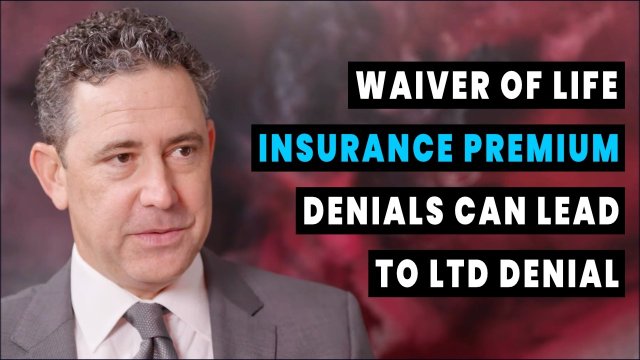
Many employees who receive long-term disability coverage through their employer also have group life insurance — and that life insurance policy often includes a valuable feature called “waiver of premium.”
When you become disabled, the insurance company waives your obligation to pay life insurance premiums so your coverage stays in force while you’re unable to work. Because a waiver of premium denial doesn’t cost you a monthly check, many claimants are tempted to let it go. In our experience, that is a serious mistake. A waiver of premium denial is frequently the first domino to fall before a long-term disability denial.
What is waiver of premium, and why do so many people overlook it?
Waiver of premium is a benefit built into many group life insurance policies. If you become disabled, you no longer have to pay premiums to keep your life insurance in force. Depending on the carrier, you may see it described differently — New York Life, for example, refers to it as an “extension of death benefits.”
Because it isn’t money in your pocket the way a monthly disability check is, a lot of claimants don’t even realize they have the benefit, and many ignore the denial when it arrives. Others assume it isn’t worth fighting for because the policy “isn’t that big” or the premium the carrier wants to charge them feels too high.
The definition of disability for waiver of premium is stricter than most LTD policies
Here is what makes these claims tricky. Most long-term disability policies begin with an “own occupation” standard for the first 24 months — meaning you only have to prove that you can’t perform the duties of your own job. A waiver of premium, by contrast, usually applies an “any occupation” standard from the very start. To qualify, you have to show that you’re unable to perform the duties of any gainful occupation, which is a much harder standard to meet.
That standard is often even tougher than the “any occupation” definition in your disability policy. Many LTD policies tie “any occupation” to an income component — for example, a job that pays at least 60% of your pre-disability earnings. Waiver of premium can be closer to the Social Security standard: if you can do almost anything, they will deny it.

Why a waiver of premium denial is a warning sign for your disability claim
This is the most important point. When a waiver of premium denial arrives, it usually shows up around 18 months into your first 24 months on long-term disability — right before your policy’s definition of disability changes from “own occupation” to “any occupation” at the 24-month mark.
The denial is built on an “any occupation” analysis and the insurer’s internal medical reviews. The same medical reviews the company uses to deny your waiver of premium are very often the exact reviews it will use to deny your long-term disability claim once that claim switches to the “any occupation” standard.
In our experience, when an insurer denies waiver of premium, roughly 80% of the time it is preparing to come after the long-term disability claim next.
The denial letter itself can add to the confusion. It often includes language stating that the decision does not affect your long-term disability claim. Read that with caution. While the two claims are technically separate, the medical file behind the denial usually tells a very different story about what is coming. If you wait until your monthly benefit is cut off to react, you have lost valuable time to build your case.
Why keeping your life insurance matters more than you think
A common reaction we hear is, “It’s only life insurance,” or “The policy isn’t worth that much, so I don’t care.” We understand the instinct, especially when the amount the carrier wants to charge you to keep the coverage feels astronomical. But losing this coverage can be costly in a way that isn’t obvious at the time.
If you have a disabling medical condition, obtaining a new life insurance policy is extremely difficult and expensive. The coverage you already have is often coverage you simply cannot replace — which is exactly why it is worth protecting.
Watch the deadline to port or convert your policy
Some carriers — New York Life and Life Insurance Company of North America among them — send a portability or conversion option along with the denial letter. Pay close attention to that deadline. If you don’t exercise your right to port or convert within the time the carrier allows, you may lose any ability to pursue the coverage at all.
Some carriers will refund the premiums you paid to convert if your appeal is later approved and the policy is restored to its group status — but you have to act within the window to preserve your rights in the first place.
How our attorneys handle a waiver of premium denial
We treat a waiver of premium denial the same way we treat a long-term disability denial. We request the claim file, analyze the basis for the denial, review the insurer’s internal medical reviews, and prepare a full, well-supported appeal designed to prove that you remain disabled under the policy’s definition.
One thing to keep in mind: because waiver of premium and long-term disability apply different standards, the two outcomes do not always match. We have seen claimants win their long-term disability appeal while the insurer still upholds the waiver of premium denial. That happened to a claimant we spoke with recently — she won her disability claim, but the carrier upheld the waiver of premium denial because of the stricter standard. That is precisely why these denials deserve their own serious attention rather than being treated as an afterthought.
Talk to a disability attorney about your waiver of premium denial
If you’ve received a waiver of premium denial on your group life insurance — whether or not your long-term disability claim has been affected yet — don’t let it slide. Treat it as a signal to get ahead of what may be coming. No matter where you live in the country, our disability insurance attorneys are available to review your denial and discuss your options. Contact us today for a FREE consultation with one of our long-term disability insurance attorneys.