Stroke Disability Insurance Benefits Claim
View Disability Cases Involving Stroke Disability Insurance Benefits Claim
A stroke can result in long term disability claim. How Can Disability Insurance Attorneys Dell & Schaefer Assist You?
As disability attorneys, Dell & Schaefer have represented numerous long term disability claimants that have been unable to work as a result of a stroke. It is the residual effects of a stroke that makes it difficult for most people to return to work. Often people who experience a stroke will have a permanent cognitive impairment. The disability carriers will often argue that a claimant’s cognitive impairment is not disabling and is not medically supported.

Disability Attorneys Dell & Schaefer have an expansive understanding of the significant restrictions and limitations that a person suffering from a stroke must live with on a daily basis. We have worked closely with top physicians in order to sufficiently satisfy a disability carrier’s threshold of evidence necessary to prove that a client is disabled by suffering a stroke.
Not everyone suffering from a stroke qualifies for long-term disability benefits, therefore the medical records of each client must be reviewed to determine the level of restrictions.
We welcome the opportunity to discuss your long-term disability claim.
You can contact us here ».
What is a stroke?
A stroke occurs when the blood supply to a part of your brain is interrupted or severely reduced, depriving brain tissue of oxygen and nutrients. Within a few minutes, brain cells begin to die. Each year 700,000 people suffer a stroke. Five hundred thousand of these strokes are first occurrences, while the rest are repeat strokes. Every 45 seconds someone in this country suffers a stroke and it causes a death every three to four minutes. Stroke is the third most common cause of death in the United States.

Many factors can increase your risk of a stroke. A number of these factors can also increase your chances of having a heart attack. Stroke risk factors include: family history of stroke heat attack or TIA (transient ischemic attack), being aged 55 or over, high blood pressure, high cholesterol, smoking, diabetes, obesity, cardiovascular disease, high levels of homocysteine (an amino acid) in your blood and the use of birth control pills or other hormone therapy. Other factors that can increase your risk of stroke include heavy drinking and the use of illicit drugs such as cocaine.
There are two types of stroke. An ischemic stroke is caused by too little blood in the brain. The cause of the other type of stroke, hemorrhagic stroke, is too much blood within the skull.
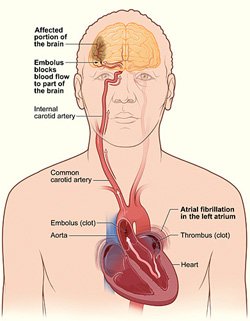
About 80 percent of strokes are ischemic strokes. They occur when the arteries to your brain are narrowed or blocked, causing severely reduced blood flow (ischemia). This deprives your brain cells of oxygen and nutrients, and cells may begin to die within minutes. The most common ischemic strokes are thrombotic strokes and embolic strokes.

Thrombotic stroke occurs when a blood clot forms in one of the arteries that supply blood to your brain. A clot usually forms in areas damaged by atherosclerosis, which is a disease in which the arteries are clogged by fatty deposits. This process can occur within any of the carotid arteries of your neck and brain.
An embolic stroke occurs when a blood clot or other particle forms in a blood vessel away from your brain, most commonly in your heart, and is swept through your bloodstream to lodge in narrower brain arteries. This type of blood clot is called an embolus. It’s often caused by irregular beating in the heart’s two upper chambers (atrial fibrillation). This abnormal heart rhythm can lead to poor blood flow and the formation of a blood clot.
Hemorrhagic stroke occurs when a blood vessel in your brain leaks or ruptures. Hemorrhages can result from a number of conditions that affect your blood vessels, including uncontrolled high blood pressure (hypertension) and weak spots in your blood vessel walls (aneurysms). A less common cause of hemorrhage is the rupture of an arteriovenous malformation (AVM), an abnormal tangle of thin-walled blood vessels, present at birth. There are two types of hemorrhagic stroke intracerebral hemorrhage and subarachnoid hemorrhage.
In an intracerebral hemorrhage stroke, a blood vessel in the brain bursts and spills into the surrounding brain tissue, damaging cells. Brain cells beyond the leak are deprived of blood and are also damaged. High blood pressure is the most common cause of this type of hemorrhagic stroke.

In a Subarachnoid hemorrhage type of stroke, bleeding starts in a large artery on or near the surface of the brain and spills into the space between the surfaces of your brain and your skull. This type of hemorrhage is often signaled by a sudden, severe headache. This type of stroke is commonly caused by the rupture of an aneurysm. After the hemorrhage, the blood vessels in your brain may widen and narrow erratically (vasospasm), causing brain cell damage by further limiting blood flow to parts of your brain.
A transient ischemic attack (TIA, or ministroke) is a brief episode of symptoms similar to those you’d have in a stroke. The cause of a transient ischemic attack is a temporary decrease in blood supply to part of your brain. Most attacks last just a few minutes but the effects can be profound. The majority of people who suffer a TIA are completely unaware of the event. Seventeen percent of all TIA’s are followed by a stroke, most within a month of the occurrence. Fifteen percent of all strokes are preceded by a TIA.
TIA has the same cause as an ischemic stroke. But in contrast to a stroke, which involves a more prolonged lack of blood supply and causes some permanent damage to your brain tissue, a TIA doesn’t leave lasting effects to your brain. Still, if you’ve had a TIA, it means there’s likely a blocked or narrowed artery leading to your brain, putting you at a greater risk of a full-blown stroke that could cause more permanent damage.
How the symptoms of stroke can affect you
If you’re having a stroke, you may stumble or have sudden dizziness, loss of balance or loss of coordination. Your speech may be slurred or may not be able to come up with words to explain what is happening (aphasia). You may experience sudden numbness, weakness or paralysis on one side of the body. You may suddenly have blurred or blackened vision or may see double.
A sudden, severe “bolt out of the blue” headache or an unusual headache, which may be accompanied by a stiff neck, facial pain, pain between your eyes, vomiting or altered consciousness, sometimes indicates a stroke.

As discussed previously, a transient ischemic attack (TIA) is another indicator of an impending stroke.
People who suffer a stroke may find themselves living with severe disabilities afterwards and find they have to change and relearn or redefine how they live their lives. They may be unable to return to work or school or require a caretaker to help them with their daily needs.
Depending on how long the brain suffers a lack of blood flow, a stroke can sometimes cause temporary or permanent disabilities. Stroke complications differ depending what part of the brain was affected. Sometimes, a lack of blood flow to the brain can cause a person to become paralyzed on one side of the body, or lose control of certain muscles, such as those on one side of the face.

A stroke may cause a person to have less control over the way the muscles in the mouth move, making it difficult to talk, swallow or eat. A person may also have difficulty speaking because a stroke has caused aphasia, a condition in which a person has difficulty expressing thoughts through language.
Some people who have a stroke may have pain, numbness, or other strange sensations in parts of their body affected by stroke. For example, if a stroke causes you to lose feeling in your left arm, you may have an uncomfortable tingling sensation in that arm. You may also be sensitive to temperature changes, especially extreme cold. This is called central stroke pain or central pain syndrome (CPS).
It’s common that people who suffer strokes have some memory loss. Others may develop difficulty understanding concepts.
Rehabilitation is a critical part of recovery for a stroke survivor and is often complex addressing multiple issues. Rehabilitation doesn’t reverse the effects of a stroke, rather its goals are to build strength, capability and confidence so a person can continue their daily activities despite the effects of the stroke. Seeking support from others who’ve experienced stroke can be a huge benefit to recovery, not only for the person who has suffered a stroke, but their family and caregivers.
Resources
There are many valuable sources of stroke information available. You can also access resources over the internet such as:
National Institute of Neurological Disorders and Stroke
Medline Plus
There are numerous charities dedicated to stroke research, detection and treatment including:
National Stroke Association
American Stroke Association
American Heart Association
Not everyone suffering from a stroke qualifies for long-term disability benefits, therefore the medical records of each client must be reviewed to determine the level of restrictions.
We welcome the opportunity to discuss your long-term disability claim.
You can contact us here ».
Request a Free Consultation
Click here or call 800-682-8331 now!
We respond the same day. We represent disability insurance claimants all over the United States.
- Disability attorney and client suffering from fibromyalgia and hypertension sue UNUM for unpaid long term disability benefits
- Massachusetts Disability Attorney filed lawsuit against the Aetna Life Insurance Company on behalf of Biogen Idec, Inc’s IT Technical Ops Lead for denial long term disability benefits
- CIGNA Life Insurance Company denies disability benefits yet social security disability benefits are approved
- Hartford wins long-term disability case based on pre-existing condition defense
- Cigna reinstates disability benefits for an accounting manager
- Jefferson Pilot’s denial of long-term disability benefits to a quality control manager is reversed
Disability benefits cases involving Stroke:
Disability Insurance Info